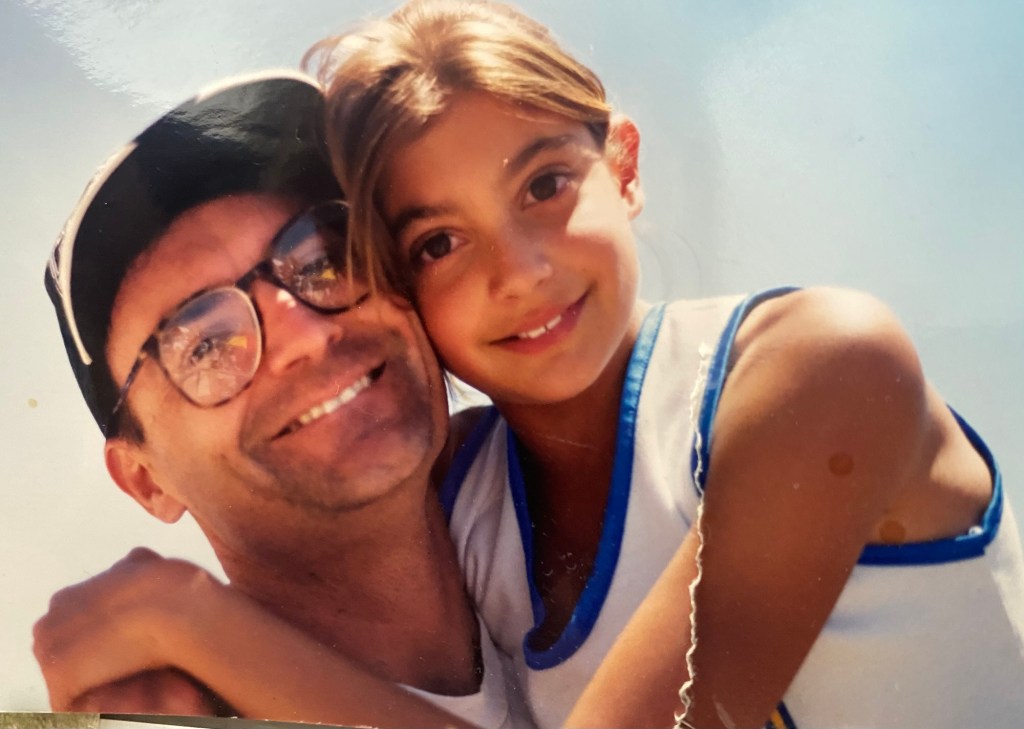
My mom got married when she was twenty-four. She was the most beautiful bride I’ve ever seen, still to this day. Just natural beauty in a beautiful dress. It made her stunning in a way a “glam squad” would cover up, hide—ruin, even. The fairy tale I grew up with was real. It was my parents’ love story. I was told over and over again how they were the most important people to one another, how they couldn’t do life without the other. I was blessed with parents who were soul mates.
Mom’s emotions ruled the house, and I saw how my dad lovingly protected them, validated them, held space for them. I grew up telling my mom, “I want a husband just like Dad!” But what I realize now is that what I was actually doing was learning how to love like my dad. I wasn’t learning how to discern a man like my father from one who was not, but instead internalizing how my dad loved his person—because I really admired it. I saw the far-reaching value in it. I saw how safe my dad made my mom feel, and while I outwardly stated, for everyone’s reassurance, “I want someone to treat me that way” (this conveys respect for yourself, confidence, “you know your worth,” etc,) what I’m realizing now is that it was more important to me to love like my dad, secretly stating: “I want to love someone that beautifully because that’s meaningful, that’s the point, and they will value it so preciously like my mom does.”
The point of love to me was not what I could get from it, but what I could give—which was everything.
And there begins my odyssey of loving men.
With the gender roles flipped, and looking back on my dating record, what can be concluded, from my personal experience, is that men will happily let you hold their emotions and protect them. They will find so much comfort in this that, by no real fault of their own, your emotions become obsolete.
While I am noticing what is happening beneath every one of their silences, they are letting mine go with a fake smile and, “I’m fine, I’m just thinking.” Very rarely will anyone ask, “What are you thinking about?” And sadly for me, if they did, and I told them the truth—“Isn’t it wild that we are going to this Halloween party, that I am dressed like a slutty fireman, while stars in a cluster are accreting from a shared reservoir of gas out in the universe? Do you ever use the competitive accretion of star formation as a way to put life into perspective? Or what about God? What would God think right now of me making an absolute mockery of a very noble profession?”—they would just laugh.
My humor has always distorted my truth. But I’m always being serious.
I want to laugh about the absurdity of everything, but I also want recognition. I was (am) always waiting for that one person who would perk up and say, “I do! What are we doing right now?” And we would turn the car around and not spend the evening being slutty firemen taking Jäger shots. We would go sit in a forest or something, look at the stars, marvel that we are here witnessing them, wonder what everything means. Something creepy and unappealing to the masses.
I was always actively participating in “society” (not life—life and society are two very, very, very different things), hoping I would find the one person who wanted to reject the “supposed to’s” and create something real, something that belonged to us: a shared life that was ours. That, to me, would be sacred.
But it’s a delicate dance, you and your relationship with yourself and you and your relationship with others.
When you spend so much time invested in someone else, you forget about yourself—what matters to you, what you want. Love should share a stage, and I can’t blame anyone for my decision to consciously and repeatedly put myself front row in someone else’s audience, cheering on the person I love.
This was easy, too. Men welcomed my viewership because I was always actively ushering them into the spotlight of their lives. I showed them their strengths, what made them unique. I told them why I loved them. I wanted them to feel strong and safe and capable. And they saw me as a reflection of themselves: beautiful, smart, funny, driven but easygoing—she wants to be with me, she loves me.
But none of them loved me. They loved how I loved them, or how I complemented their lives.
Luckily, I have never surrendered myself completely to anyone. There always came a tipping point when my inner self would stand up and start yelling at me, reminding me that this was great and all—to love others—but you are quite literally wasting away into nothing, and for what? This dummy playing video games?
And that’s when I would run. And unfortunately, I am very fast (I grew up running track).
But I was never running away from them. I was running back to myself.
This is the repeating pattern of my life. I think maybe we all have one, and once we discover it is when we truly start to find peace. I’m not sure there is an age when you are “supposed” to wake up. It can happen at any time. Some wake up earlier than others, but the point is: you can’t find love when you are asleep. You have to look in the mirror with clear eyes before anyone else will see you the same way.
I’m worried about writing this next part because it might make me a bad mother.
The person who helped me break this pattern of mine is Noah, my son.
He is the first man (boy… toddler) who reflects back the love you show him. He is in tune with all of my emotions, just like I am with him. In the car, waiting at a red light while I’m getting tense over traffic and being late to work, he will reach out his hand and say, “Mama, let’s play rock-paper-scissors at every red light.” And we will. And my tension will dissolve into so much love for him.
I’m panicking about being late, losing my job, not being able to afford anything for him—but what matters right now, in this moment of breath on this planet where we are merely specks, is joyfully playing rock-paper-scissors. His face smiling, our eyes connected—we are connected and in our own little world, safe.
Whatever happens, whatever comes next, we are together.
He notices when my eyes change. He searches my face. He holds my hand. I can see him all grown up, looking at someone the same way, offering up his love to them as reassurance: I’m here with you.
And when he cries, I snuggle him, and we sit in his feelings. We share them together. Sometimes there don’t need to be solutions. Sometimes solutions only make us feel like our emotions are something to be “fixed,” not felt.
I hope that one day, when he’s in love, he can make whoever he loves feel less alone in the wilderness in this same way. My dad’s lesson in love will carry on into eternity.
That is love.
 Word Vomit
Leave a comment